
How to do Keyword Research for SEO
Let’s be honest. Keyword statistics are probably not what you have signed up for when you started your business.
But what if I told you that understanding what your audience types into Google… is actually a doorway into their minds?
A doorway into their struggles., their hopes and their “I’m ready for something more”-moments.
With the right approach, how to do keyword research for SEO becomes a smart, intuitive way to connect your message with the people who actually need and want to hear it.
Whether you’re running retreats, building a conscious brand, or guiding others through transformation — this is how your marketing starts working for you and giving you valuable insights into what your audience really wants and needs.
Key Takeaways: How to do Keyword Research for SEO
-
- Keyword research is the key to SEO that actually connects you with those who are already looking for what you have to offer.
-
- By 2025, it is less about algorithms, but rather about human intent, and showing up with value.
-
- You don’t have to be an expert in order to do so. By having a clear procedure and some useful tools, you can begin ranking as well as attracting the proper audience.
-
- Selecting appropriately targeted (not overly popular) words is what makes small businesses competitive—even without having big budgets.
-
- Being seen is an ongoing effort, never a once-and-done activity. But it’s one worth it in the long run.
How to Do Keyword Research for SEO (Without Overwhelm)
You don’t need a marketing degree (or hours spent decoding SEO forums) to get keyword research right. All it really takes is a clear process, a few free tools, and a genuine curiosity about how your people search for help online. Once you understand what they’re typing into Google, you can show up with content that speaks directly to their needs.
That’s why I’ve broken it down into a simple, step-by-step guide—so you can stop guessing and start getting found.
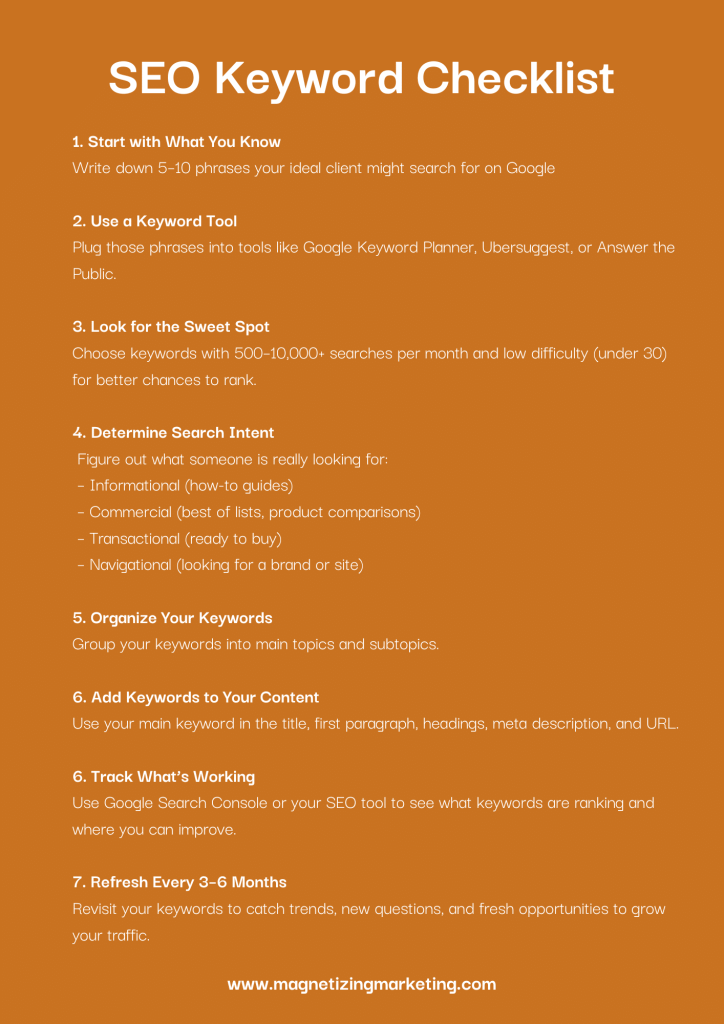
Step 1: Start With What You Know
Before diving into tools, take a moment to reflect:
-
- What services or products do I offer?
-
- What problems do I solve?
-
- What questions do people keep asking me?
Pro Tip: Start With Search Intent (Not Just Search Terms)
This is where 90% of people get it wrong.
Don’t just think about what you want to rank for—think about what your audience is actually typing into Google. In most cases, people don’t look for the solution to their problem, because they simply don’t know the solution yet. Instead, they are searching for HOW TO solve their problem.
Examples:
-
- No: “Transformational Coaching for Women”
-
- Yes: “how to stop negative thinking”
🔍 This shift alone can double your traffic.
Journal Prompt:
Write down 5–10 phrases or problems your ideal client might type into Google when searching for someone like you.
-
- What is your audience struggling with? What are their goals?
-
- What problem does your offering solve?
More examples (for a life coach): “stop overthinking”, “coaching for anxious individuals”, “finding purpose in life”
Step 2: Use a Keyword Research Tool
Now plug those phrases into a keyword tool. Here are three great (and beginner-friendly) picks:
🔍 Here’s how to Use the Top SEO Tools:
1. Google Keyword Planner (Free)
Honestly, every business should have a Google Ads account, even though you are not planning on running ads just yet. The free Keyword Planner that comes with it is an absolute gamechanger when it comes to effective SEO keyword research.
-
- Log into your or create a new Google Ads account (don’t worry, it’s free)
-
- Go to “Tools & Settings” > “Keyword Planner.”
-
- Click Discover New Keywords.
-
- Enter those keywords you have just noted in step 1.
-
- Click “Get Results.”
👉 This will show you average monthly searches, keyword ideas, and competition levels.
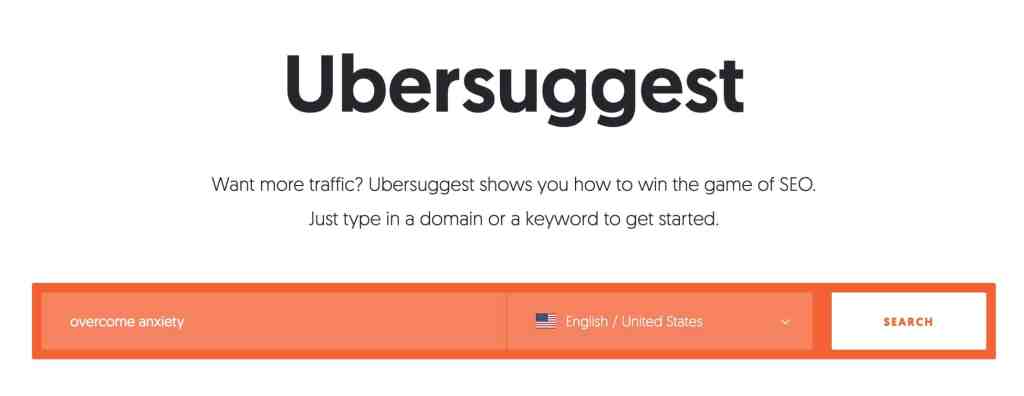
2. Ubersuggest (free with optional upgrades) Best for: Beginners
-
- Free version lets you search a few terms per day
- Content ideas
- You’ll see:
-
- SEO difficulty
- Search volume
-
3. Answer the Public (Freemium) Best for: Finding real questions that people ask on the internet & search intent
Enter a broad term like “burnout”.
You’ll get real user questions like: “Can burnout cause anxiety?”

4. SEMrush / Ahrefs (Advanced)
-
- Deep competitor analysis
-
- Backlink profiles
-
- Content gap discovery
💰 These are paid tools—best when you’re scaling up.
Step 3: Find “Sweet Spot” Keywords
When evaluating a keyword, keep an eye on:
| Metric | Meaning | Ideal Range (Small Biz) |
|---|---|---|
| Search Volume | How many search it monthly | 500–10,000 |
| Keyword Difficulty | Competition level | Under 30 |
| Search Intent | What the searcher is looking for | Align with your service |
Example: When looking up the keyword “overcome anxiety”, the monthly search volume is 1900 – a number that looks promising. However, the SEO difficulty is in the high area, meaning that there is most likely a lot of competition.

🪄 Pro Tip: Use long-tail keywords like “how to deal with anxiety attacks” — they’re more specific and less competitive than broad terms. Ubersuggest can give you suggestions.

Step 4: Determine Search Intent (and Why It Matters)
1. Informational Intent
The searcher is looking to learn something.
These searches often start with:
-
- “how to…”
-
- “what is…”
-
- “tips for…”
-
- “why does…”
Examples:
-
- “how to host a retreat”
-
- “what is inner child work”
-
- “benefits of somatic healing”
✅ Best content match:
-
- Blog posts
-
- Guides & how-tos
-
- Infographics or videos
-
- Podcast episodes or interviews
🎯 Goal: Build trust, position yourself as an expert, and introduce your services subtly. Great for top-of-funnel content.
2. Navigational Intent
The searcher wants to go to a specific site or platform.
These searches are branded or very specific. The user already knows what they’re looking for.
Examples:
-
- “Insight Timer login”
-
- “OpenAI ChatGPT homepage”
-
- “Marie Forleo blog”
✅ Best content match:
-
- Make sure your own website is optimized for your brand name
-
- Use branded keywords in your homepage, About page, and navigation
-
- Ensure your Google My Business is updated
🎯 Goal: Be easy to find. This traffic likely already knows you — don’t lose them to confusion or poor SEO.
3. Transactional Intent
The searcher is ready to make a purchase or take action.
These are people at the bottom of the funnel. They know what they want — now they’re looking for the right place to buy.
Examples:
-
- “buy sound healing bowl”
-
- “book a breathwork session”
-
- “life coach for burnout near me”
✅ Best content match:
-
- Service pages
-
- Product pages
-
- Booking forms
-
- Sales landing pages
🎯 Goal: Keep it clear, compelling, and conversion-focused. Don’t write a 3,000-word blog for someone who’s ready to buy — give them a button to book or buy now.
4. Commercial (a.k.a. Commercial Investigation or what we call “money keywords” in Marketing language)
The searcher is comparing options before making a decision.
They’re not quite ready to purchase — but they’re weighing the pros and cons, reading reviews, and looking for the best choice.
Examples:
-
- “best retreat centers in Bali”
-
- “top sound baths in LA”
-
- “life coach vs therapist”
✅ Best content match:
-
- Comparison guides
-
- Review-style blog posts
-
- Case studies
-
- Pricing breakdowns
🎯 Goal: Help them make a decision — ideally, in your favor. This is the moment to show your credibility, uniqueness, and value.
Final Tip: When doing keyword research, tag each keyword with its intent type. That way, you know exactly what kind of content you need to create — and what action to encourage.
Step 5: Organize Your Keywords
Sort your keywords into two groups:
Main keyword – The star of your blog post or page
Secondary keywords – Related ideas that support your content
Step 6: Use Keywords Naturally
This is the time where we finally use our keywords. How? There is a simple success formula that will make you rank higher:
For all keywords related to your main offering, create one page per keyword. For more informational content create blog posts.
Place your main keyword in:
-
- Your blog/page title
-
- The opening paragraph
-
- Multiple subheadings
-
- Meta title & description
-
- The URL (if it’s a new page)
Sprinkle your secondary keywords naturally throughout. Keep it helpful, not robotic.
Step 7: Track What’s Working & Improve Consistently
Use this tool to keep tabs on your keywords:
-
- Google Search Console (Free) – See what you rank for & how many clicks you get
Step 8: Revisit Your Keywords Every 3–6 Months
If you don’t see results right away, don’t worry. Results from SEO work take a few months to be visible (depending on the search volume of each keyword).
Plus, trends shift. New questions come up. So check back every few months:
-
- What’s getting traffic?
-
- What’s ranking but not leading to results?
-
- Are new keywords trending?
Treat keyword research as part of your content planning, not just a one-off task.
Summary: How to do Keyword Research for SEO in 2025
Keyword research may seem like something that only SEO experts and marketing staff are doing, but the reality is it can be one of the most empowering things that you can possibly do as a small business owner. Because once you understand how your ideal clients are searching, you can meet them there—with content, deals, and answers that feel like just what they were looking for.
Marketing isn’t about algorithms and numbers anymore – it’s about creating community and sharing your message with the people who need to hear it.
Need Assistance Implementing This?
If you need 1:1 marketing guidance for clarity and assurance, or prefer to pass on your SEO approach over to the experts, I provide both done-for-you SEO as well as collaborative SEO coaching.
Let’s connect to that those who are looking for your services can actually find you.
Your Questions Answered: How to do Keyword Research for SEO
What are SEO keywords and why are they important?
SEO keywords are the words and phrases people type into Google when they’re searching for something. These keywords help search engines figure out what your content is about. When you use the right ones, your site becomes easier to find, bringing in more organic traffic and connecting you with people actively looking for what you offer.
How many SEO keywords should I use?
Stick with one main keyword and 2–4 related secondary ones per page or blog post. Use your main keyword in the title, first paragraph, headings, and meta tags. Then weave the secondary keywords naturally throughout your content. Don’t force it—just aim for relevance and flow.
How often should I do keyword research for my business?
Plan to refresh your keyword research every 3–6 months. Trends and search behaviors shift, so staying current helps you stay visible. Check in on what’s working, look for new keyword opportunities, and tweak your content plan to keep your SEO strategy sharp.
Can small businesses really rank on Google?
Absolutely. Small businesses can show up on Google by focusing on keywords that are relevant and not overly competitive, optimizing their website for speed and mobile, and consistently creating helpful, keyword-focused content. Local SEO and regular blogging go a long way—even if you don’t have a big marketing budget.
How do I choose SEO keywords for my business?
Start by identifying what your audience is searching for. Use keyword tools like SE Ranking or Ubersuggest to find phrases with high search volume and low difficulty. Look for keywords that match your offers and your clients’ intent, then narrow them down by relevance and ranking opportunity.
How do I get found through SEO?
To get found through SEO, create valuable content around keywords your audience is searching. Optimize your website structure, speed, and mobile experience. Use internal links, meta tags, and clear calls to action. Most importantly, stay consistent—SEO success builds over time.
How to keyword research for SEO?
Start by brainstorming topics your audience cares about. Then, use tools like Ubersuggest, Google Keyword Planner, or Answer the Public to explore related search terms, how often they’re searched, and how competitive they are. Look for terms your ideal clients are already Googling — and build content around them.
What is the best keyword research tool for SEO?
There’s no one-size-fits-all tool, but some great options are Google Keyword Planner, SE Ranking (for tracking and competitor research), Ubersuggest (great for beginners), and Answer the Public (for real questions people ask). Choose based on your skill level and goals.
What keywords are best for SEO?
The best keywords are relevant to your offer, get consistent monthly searches (500–5,000+), and aren’t overly competitive. Long-tail keywords, specific phrases — like “retreat for burnout recovery” — often work better for conscious or niche businesses.
Is SEO the same as keyword research?
Not quite. Keyword research is one piece of SEO — it helps you find the right words to target. But SEO also includes things like writing helpful content, optimizing your website, improving page speed, and building links.
How to do SEO for beginners?
If you’re just getting started with SEO, focus on the basics:
-
- Do keyword research
-
-
- Write valuable content
-
- Use keywords in your titles and meta descriptions
-
- Link between pages on your site
-
- Track what’s working with Google Search Console
How do I find effective SEO keywords?
Use a keyword tool to explore what your audience is searching for. Look for terms with a mix of decent volume, low-to-medium competition, and clear intent. Bonus: Check out what your competitors are ranking for and borrow what fits your niche.
What are the 4 types of keywords in SEO?
There are four types based on search intent:
-
- Informational – “how to host a retreat”
-
- Navigational – “Insight Timer login”
-
- Transactional – “book sound healing session”
-
- Commercial – “best yoga retreats in Bali”
How much does SEO cost?
SEO can be free if you’re doing it yourself using basic tools. If you hire someone, it can range from $500 to $5,000+ per month depending on your needs, industry, and the level of service.
Do SEO keywords need one word?
Nope — and in fact, single-word keywords are usually way too competitive. Multi-word phrases (a.k.a. long-tail keywords) like “somatic coach for entrepreneurs” tend to perform better for small businesses and niche markets.
About the Author: Laura Born


